A great exhibition can inspire, challenge, and stay with visitors long after they leave the gallery. But if museums only measure attendance, they miss the richer story: how people felt, what they understood, where they struggled, and what could have made the experience even better. That’s where effective exhibition feedback becomes essential.
The most useful insights are often gathered in the final moments of a visit, when impressions are still fresh and visitors can easily reflect on what stood out. The right questions can reveal far more than overall satisfaction alone. They can uncover whether interpretation was clear, signage was helpful, spaces felt accessible, exhibits flowed well, and the experience delivered the emotional or educational impact curators intended.
In this article, we’ll explore the key exhibition feedback questions museums should ask before visitors leave, and why the wording, timing, and format of those questions matter. We’ll also look at how smarter survey design can improve response rates, support better visitor experience decisions, and help institutions turn real-time insight into practical action. For museums looking to capture feedback at the point of experience, tools like Tapsy can also make that process faster and more visitor-friendly.
Why exhibition feedback matters before visitors exit

Capture impressions while the experience is still fresh
Collecting exhibition feedback at the exit gives museums a clearer picture of what visitors actually experienced. Memories fade quickly, and delayed follow-up surveys often miss important details about gallery flow, signage, emotional impact, and standout exhibits. An on-the-spot exit survey captures reactions while they are still vivid, making responses more accurate, specific, and useful for improvement.
Key benefits include:
- Stronger recall: Visitors remember what confused, delighted, or frustrated them.
- More emotional honesty: Immediate responses reflect real feelings, not revised opinions.
- More practical insight: Teams can identify issues like crowding, wayfinding, or accessibility barriers.
- Faster action: Real-time visitor feedback helps staff fix problems before they affect more guests.
Simple tools such as QR-based exit points or platforms like Tapsy can make this process quick and frictionless.
Connect feedback to visitor experience goals
Strong exhibition feedback starts with a clear purpose: what should visitors think, feel, learn, or do after the visit? A well-designed museum visitor survey should map directly to those goals so teams can measure whether the exhibition delivered its intended visitor experience.
- Learning outcomes: Ask what visitors understood, remembered, or discovered.
- Enjoyment: Measure emotional impact, relevance, and overall visitor satisfaction.
- Accessibility: Check ease of navigation, label clarity, seating, audio, and inclusive design.
- Dwell time: Ask whether pacing felt right and which areas held attention longest.
- Repeat visitation: Include intent-to-return and likelihood to recommend.
Keep questions short and specific. For example, a quick exit survey or tools like Tapsy can capture in-the-moment insight that helps curators improve both content and delivery.
Turn comments into operational and curatorial improvements
Well-structured exhibition feedback helps museums move from opinion to action. In effective museum survey design, open comments often reveal issues that scores alone miss, giving teams richer visitor insights for day-to-day fixes and long-term planning.
- Wayfinding: spot confusing routes, unclear signage, or missed entrances and exits.
- Interpretation: identify labels that feel too technical, too dense, or inconsistent with visitor expectations.
- Layout and flow: uncover bottlenecks, crowding, poor sightlines, or inaccessible display placement.
- Staffing and interactives: flag moments where visitors needed more support, clearer instructions, or better-maintained hands-on elements.
- Content clarity: show where themes, timelines, or object significance are not landing.
Used consistently, museum exhibition evaluation becomes a practical tool for both front-of-house teams and exhibition planners, helping prioritise quick fixes and future improvements.
The essential exhibition feedback questions to ask

Questions about overall satisfaction and enjoyment
A strong exhibition feedback section should quickly reveal whether visitors valued the experience and why. In your visitor satisfaction survey or museum feedback form, include a mix of simple ratings and short open-text prompts so you capture both measurable trends and useful detail.
Consider asking:
- How would you rate the exhibition overall?
Use a 1–5 or 1–10 scale for easy benchmarking across exhibitions. - What did you enjoy most about your visit?
This highlights standout displays, themes, or interactive elements. - Did the exhibition meet your expectations?
Offer options such as “Exceeded,” “Met,” or “Did not meet expectations.” - Would you recommend this exhibition to others?
This helps measure advocacy and word-of-mouth potential.
To improve your exhibition feedback questions, balance closed and open formats:
- Start with one or two rating-scale questions for fast completion.
- Follow with one optional comment box to explain scores.
- Keep wording specific and neutral to avoid leading responses.
If you collect feedback on-site through QR codes or touchpoints, tools like Tapsy can help museums capture fresh reactions before visitors leave.
Questions about learning, relevance, and emotional impact
Strong exhibition feedback should go beyond satisfaction scores and uncover what visitors actually took away from the experience. To measure museum learning outcomes, include questions that reveal knowledge gain, personal connection, and emotional response.
Consider asking:
- What is one thing you learned today?
This open question helps identify whether key messages were understood and remembered. - Did anything surprise you or change your perspective?
Useful for spotting moments of discovery and assessing cultural impact. - How relevant did the exhibition feel to your life, community, or current issues?
This shows whether content connected with visitors beyond the gallery space. - How did the exhibition make you feel?
Offer options such as inspired, moved, challenged, curious, uncomfortable, or hopeful, with space for comments. - Do you want to learn more about this topic after your visit?
A strong indicator of audience engagement and lasting interest.
These exhibition evaluation questions help museums understand not just what visitors liked, but what resonated intellectually and emotionally. Tools such as QR-based surveys or touchpoint platforms like Tapsy can capture these insights while the experience is still fresh.
Questions about accessibility, navigation, and practical barriers
Strong exhibition feedback should reveal where the visitor journey becomes harder than it needs to be. Museums often learn the most from practical friction points that affect comfort, confidence, and time spent engaging with displays.
Use inclusive survey questions such as:
- Were exhibition labels easy to find, read, and understand?
- Did you experience any difficulty navigating routes, stairs, lifts, or narrow spaces?
- Were any galleries too crowded to comfortably view objects or interactives?
- Did sound, lighting, or screen effects create sensory overload at any point?
- Were digital or hands-on interactives accessible and easy to use for all visitors in your group?
- Did wayfinding signs clearly guide you to key spaces such as toilets, exits, and quieter areas?
To improve museum accessibility, keep response formats simple, offer multiple languages, and provide both rating and open-comment options. It also helps to ask whether visitors used mobility aids, visited with children, or needed low-sensory spaces—without making disclosure mandatory.
Tools like Tapsy can help museums collect this feedback at specific touchpoints, making barriers easier to identify and fix quickly.
How to design a museum survey visitors will actually complete

Keep surveys short, simple, and easy to answer
For effective exhibition feedback, brevity matters. Visitors are often leaving, tired, or distracted, so a short exit survey will outperform a long form every time.
- Aim for 3–5 questions for immediate exit feedback
- Keep completion time to under 60 seconds
- Use plain, specific language instead of internal jargon
- Mix quick ratings with one optional open comment
- Avoid asking two things in one question
Good survey design reduces drop-off and improves answer quality. A focused museum questionnaire might ask about overall satisfaction, clarity of interpretation, ease of navigation, and likelihood to return. If you use QR-based tools such as Tapsy, keep the flow fast and mobile-friendly to minimise response fatigue and capture fresher insights.
Choose the right mix of question types
The best exhibition feedback surveys combine a few survey question types so visitors can respond quickly without losing nuance.
- Rating scales: Use a Likert scale survey for satisfaction, clarity, flow, or value. These are easy to answer and ideal for spotting trends across exhibitions.
- Multiple choice: Best when you need clear categories, such as “Which part of the exhibition was most memorable?” This makes analysis faster and more reliable.
- Yes or no: Use for simple checks, like whether signage was easy to follow or whether visitors would recommend the exhibition.
- Open-ended questions: Reserve one optional prompt for open-ended feedback, such as “What would you improve?” This captures detail that scores alone miss.
A practical rule: ask 2–3 closed questions, then one optional comment. Tools like Tapsy can help keep this process fast at exit points.
Ask unbiased questions that produce useful data
Good exhibition feedback starts with neutral wording. If questions suggest a “right” answer, your data becomes less reliable and harder to act on. Strong visitor research methods focus on clarity, simplicity, and one idea at a time.
- Avoid leading wording: replace “How inspiring was our excellent new exhibition?” with “How would you rate the exhibition?”
- Avoid double-barrelled questions: don’t ask “Was the exhibition informative and easy to follow?” Split it into two separate questions.
- Avoid vague prompts: instead of “What did you think?”, ask “How clear was the exhibition layout?” or “How satisfied were you with the interpretation panels?”
These unbiased survey questions follow core survey best practices, making results easier to compare, analyse, and turn into better curatorial, operational, and visitor experience decisions.
When and where to collect exhibition feedback

Best moments to ask before visitors leave
Choosing the right survey timing is essential if you want to collect visitor feedback while the experience is still fresh. The best moments usually balance convenience with reflection:
- Gallery exits: Ideal for immediate exhibition feedback on content, flow, and emotional impact.
- Final interpretation points: Useful when visitors have just finished reading or engaging with the exhibition’s closing message.
- Café areas: Good for slightly longer responses, as visitors are seated and less rushed.
- Retail spaces or the museum exit point: Best for quick ratings, but keep surveys short to avoid drop-off.
In general, earlier prompts improve detail, while later prompts can increase completion rates if the setting feels relaxed. Tools like Tapsy can help place short, no-app surveys at these touchpoints.
Digital, in-person, and hybrid collection methods
For stronger exhibition feedback, use a mix of channels rather than relying on one method alone:
- Review tablets or a museum feedback kiosk: fast, visible, and easy to complete on-site; great data quality, but higher hardware and maintenance costs.
- QR code survey and SMS links: low-cost, flexible digital feedback tools that work well at exits, labels, or cafés. Convenient for smartphone users, but less accessible for visitors with low digital confidence.
- Email follow-ups: useful for longer reflections after the visit, though response rates are usually lower and feedback is less immediate.
- Staff-led interviews: deliver rich, nuanced insights, but take more time and staffing.
- Paper forms: accessible and familiar, yet slower to process and harder to analyze.
A hybrid setup—such as kiosks plus QR codes and occasional staff interviews—usually delivers the best balance of convenience, accessibility, cost, and data quality.
Train staff to invite feedback effectively
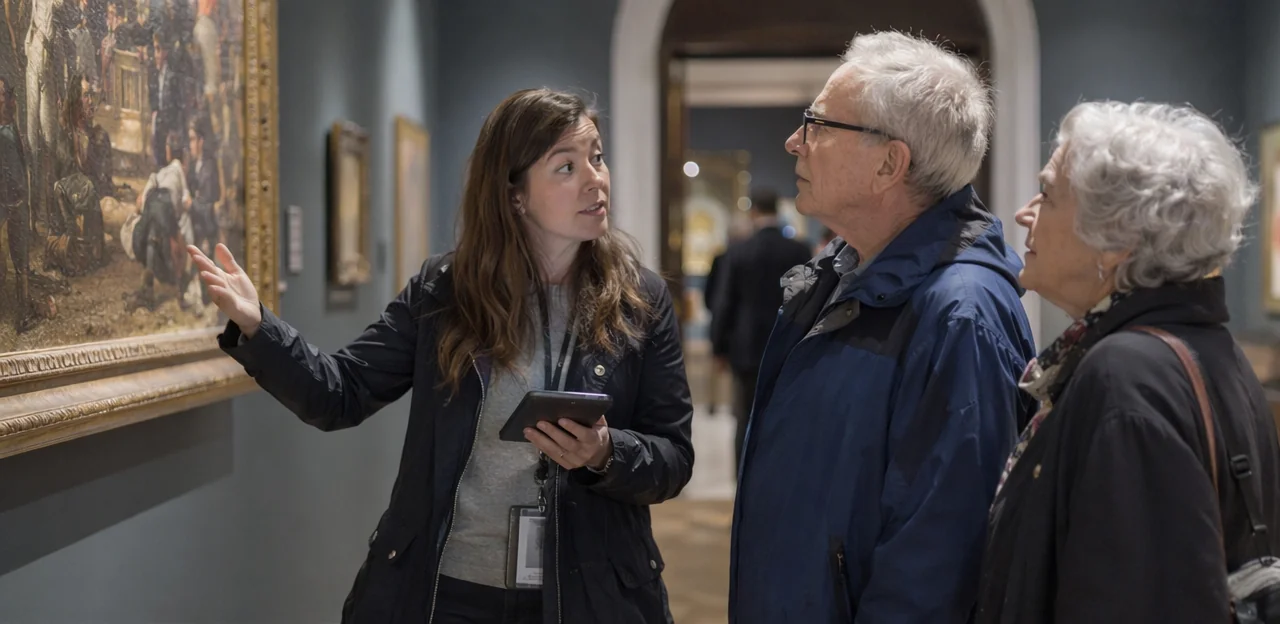
Strong front of house training helps teams ask for exhibition feedback in a way that feels friendly, not forced. Give staff a simple script that explains why the survey matters and keeps the ask brief.
- Ask at the right moment: Invite feedback as visitors exit, return audio guides, or pause at key touchpoints.
- Explain the purpose: Use lines like, “Your feedback helps us improve future exhibitions and visitor services.”
- Keep it low-pressure: Make clear participation is optional and should only take a minute.
- Point to easy formats: QR codes or tap-to-rate tools such as Tapsy can increase survey response rate.
- Reassure visitors: Emphasise that responses directly support the museum’s visitor engagement strategy and future experience improvements.
How museums should analyze and act on feedback

Identify patterns in ratings and comments
To get real value from exhibition feedback, look beyond overall scores and group responses into clear themes. This makes it easier to analyze survey results and turn them into practical improvements.
- Sort feedback by topic: interpretation, accessibility, family experience, exhibition flow, signage, and staff support.
- Compare scores with comments: a low rating for flow paired with remarks about bottlenecks or confusing layouts gives stronger direction than numbers alone.
- Tag recurring language: note repeated words such as “crowded,” “unclear,” or “engaging” to strengthen your visitor feedback analysis.
- Segment by audience type: families, older visitors, members, and first-time guests often reveal different museum audience insights.
Tools like Tapsy can help teams track these themes in real time across touchpoints.
Use exhibition feedback to sort issues by effort and impact, so teams can improve visitor experience quickly without losing sight of bigger museum improvements.
- Quick wins: Fix problems you can solve in days, such as revising confusing labels, adding benches in high-dwell areas, or improving directional signage.
- Medium-term fixes: Tackle changes that need coordination or modest budget, like adjusting gallery flow, updating lighting, or repositioning interactives.
- Strategic changes: Reserve larger patterns in actionable feedback for future exhibition planning, including narrative structure, accessibility design, or room layout.
A simple tagging system in your survey process—or a tool like Tapsy—helps teams prioritise and act faster.
Close the loop with teams and visitors
A strong feedback loop turns exhibition feedback into visible improvement. Share findings internally so the right people can act quickly:
- Curators: refine interpretation, object labels, and narrative flow
- Educators: adjust learning materials, tours, and family activities
- Operations staff: fix signage, seating, accessibility, and crowd flow issues
Just as importantly, share key updates with visitors where appropriate—on signage, email newsletters, or social posts. A simple “You said, we changed” message strengthens visitor trust and shows participation matters. This kind of museum team collaboration helps museums respond faster, align departments, and encourage more honest feedback next time. Tools like Tapsy can help route insights to the right teams in real time.
Sample exhibition feedback framework museums can adapt
A five-question core survey template
Use this museum survey template as a simple exhibition feedback template museums can adapt for any gallery, temporary show, or family trail:
- Overall, how satisfied were you with the exhibition?
- What did you learn or discover today?
- Did you experience any accessibility or wayfinding barriers?
- What was the highlight of your visit?
- What should we improve next time?
These visitor survey questions create a flexible starting point for venues of any size.
Optional questions for families, members, and school groups
Keep core exhibition feedback short, then add 1–2 audience-specific prompts to compare segments clearly:
- Families: Was the exhibition easy for children to follow and enjoy?
- Members: Did this visit strengthen the value of your membership?
- School groups: Did the content match learning goals and suit the group’s age?
These targeted prompts improve family visitor feedback, museum membership survey results, and school group evaluation without overloading every visitor.
Common mistakes to avoid in exhibition feedback surveys
Avoid these common survey mistakes when collecting exhibition feedback:
- Asking too many questions: long surveys reduce completion rates and weaken insight.
- Ignoring exhibition goals: avoid museum evaluation errors by tying questions to learning, engagement, and visitor flow objectives.
- Overlooking accessibility: use clear language, readable formats, and inclusive response options.
- Collecting feedback without action: review results regularly and turn findings into improvements.
These feedback survey tips help museums gather better, more useful data.
Conclusion
Great exhibitions do more than inform or inspire—they listen. By asking the right questions before visitors leave, museums can turn a one-time visit into meaningful insight that improves interpretation, accessibility, flow, engagement, and overall satisfaction. The most effective exhibition feedback is timely, simple, and specific: what visitors understood, what they felt, where they struggled, and what would make the experience better next time.
Rather than relying on long post-visit surveys with low response rates, museums should focus on concise, well-placed prompts at key moments, especially near exits or after standout installations. This approach helps teams capture honest reactions while the experience is still fresh and gives curators, visitor experience teams, and leadership clearer direction for future decisions.
If you want stronger exhibition feedback, the next step is to review your current survey design, reduce friction, and test questions that reveal both emotional response and practical barriers. You can also explore tools such as Tapsy to collect quick, no-app feedback at physical touchpoints across exhibitions and visitor spaces.
Ultimately, better exhibition feedback leads to better exhibitions. Start small, measure consistently, and use every response as an opportunity to create more memorable, inclusive museum experiences.
Frequently Asked Questions
- Why should museums collect exhibition feedback before visitors leave?
Exit feedback captures impressions while the visit is still fresh. Visitors can more accurately recall what confused, delighted, or frustrated them, including issues with flow, signage, accessibility, and emotional impact. This also helps teams act faster on problems affecting current visitors.
- What should exhibition feedback measure besides overall satisfaction?
Useful feedback should also measure learning, enjoyment, accessibility, navigation, dwell time, and intent to return or recommend. Museums can ask what visitors understood, how relevant the content felt, and whether any practical barriers affected the visit. This gives a fuller picture than a single satisfaction score.
- What are the most important questions museums should ask in an exit survey?
A strong core set includes overall satisfaction, what the visitor learned or discovered, whether they faced accessibility or wayfinding barriers, what stood out most, and what should be improved. These questions balance experience, learning, and practical issues. They also work well as a short survey that visitors can complete quickly.
- How long should a museum exhibition survey be?
A short exit survey of 3 to 5 questions is recommended. It should take under 60 seconds to complete, using plain language and simple response formats. Keeping it brief reduces drop-off and improves response quality.
- Which question types work best for exhibition feedback?
The most effective mix is usually 2 to 3 closed questions followed by one optional open comment. Rating scales help track satisfaction, clarity, and flow, while multiple choice and yes-or-no questions make analysis easier. An open-ended prompt captures details that scores alone can miss.
- How can museums write unbiased exhibition feedback questions?
Questions should use neutral wording and focus on one idea at a time. Museums should avoid leading phrases, vague prompts, and double-barrelled questions such as asking whether something was both informative and easy to follow. Clear, specific wording produces more reliable data.
- What should museums ask to understand learning and emotional impact?
Good prompts include asking what visitors learned, whether anything surprised them, how relevant the exhibition felt, and how it made them feel. Museums can also ask whether visitors want to learn more after the visit. These questions reveal both intellectual takeaway and emotional response.
- How can museums use feedback to identify accessibility and navigation problems?
They should ask whether labels were easy to find and understand, whether routes or spaces were difficult to navigate, and whether lighting, sound, or crowding created barriers. Questions can also cover interactives, wayfinding signs, and access to toilets, exits, or quieter areas. Simple response formats and optional comments help surface practical friction points.
- Where is the best place to ask visitors for exhibition feedback?
Good locations include gallery exits, final interpretation points, café areas, and the main museum exit. Earlier prompts often capture more detailed reactions, while more relaxed spaces may improve completion rates. The best choice depends on whether the goal is speed, reflection, or both.
- What collection methods can museums use for exhibition feedback?
Museums can use review tablets, kiosks, QR code surveys, SMS links, email follow-ups, staff-led interviews, and paper forms. Each method has trade-offs in convenience, accessibility, cost, and data quality. A hybrid approach often gives the best balance.
- How should front-of-house staff invite visitors to complete a survey?
Staff should ask at natural moments such as when visitors exit, return audio guides, or pause at key touchpoints. The invitation should be brief, friendly, and low-pressure, with a simple explanation that feedback helps improve future exhibitions and visitor services. Clear directions to easy formats like QR codes or tap-to-rate tools can increase participation.
- How should museums analyze exhibition feedback once it is collected?
Responses should be grouped into themes such as interpretation, accessibility, flow, signage, family experience, and staff support. Museums should compare ratings with comments and tag recurring language like 'crowded' or 'unclear' to spot patterns. Segmenting responses by audience type can also reveal different needs among families, members, older visitors, and first-time guests.
- How can museums turn visitor comments into practical improvements?
A useful approach is to sort issues by effort and impact. Quick wins might include clearer labels, better signage, or more seating, while medium-term fixes could involve lighting, flow, or interactive placement. Larger recurring issues can inform future exhibition planning and accessibility design.
- What is a simple exhibition feedback framework museums can adapt?
A practical five-question framework asks about overall satisfaction, learning or discovery, accessibility or wayfinding barriers, the highlight of the visit, and what should be improved next time. This structure works across galleries, temporary exhibitions, and family trails. Museums can then add one or two audience-specific questions for groups like families, members, or school visits.
- What common mistakes should museums avoid in exhibition feedback surveys?
The main mistakes are asking too many questions, ignoring the exhibition's goals, overlooking accessibility, and failing to act on the results. Long surveys reduce completion rates and weakly targeted questions produce less useful insight. Feedback becomes valuable only when it is reviewed regularly and turned into visible improvements.