In busy travel and mobility hubs, every touchpoint shapes the passenger journey. A spotless restroom, a fast-moving service counter, a comfortable lounge, or a well-managed platform can influence how travelers perceive the entire station. Yet many operators still struggle to capture feedback at the exact moment an experience happens—when it is most accurate, actionable, and valuable. That is where a well-designed station feedback system can make a measurable difference.
By placing simple feedback tools at toilets, platforms, counters, and lounges, stations can gather real-time insight into cleanliness, wait times, staff interactions, comfort, and safety. Instead of relying only on delayed surveys or public complaints, operators can spot issues early, respond faster, and improve passenger satisfaction across the whole hub. Solutions such as Tapsy also show how QR- or NFC-based feedback can be collected without adding friction for travelers on the move.
This article explores how station feedback systems work in high-traffic environments, why survey design matters for response quality, and which touchpoints offer the greatest operational value. It will also look at how real-time passenger feedback supports better service recovery, stronger performance tracking, and a more seamless travel experience from arrival to departure.
Why a Station Feedback System Matters in Travel & Mobility Hubs

A station feedback system is a touchpoint-based method for collecting passenger feedback at the moment of experience—such as in toilets, on platforms, at service counters, or inside lounges. In busy hubs, conditions change by the minute, so continuous input helps teams respond before minor issues become complaints, delays, or safety concerns.
- Real-time visibility: Spot cleanliness, queue, noise, signage, or staffing problems as they happen.
- Faster service recovery: Route low scores or urgent comments to the right team for immediate action.
- Better transport hub experience: Use live trends to adjust staffing, maintenance, and passenger communications during peak flows.
For operators, a station feedback system turns scattered reactions into operational insight. Solutions like Tapsy can help capture feedback instantly at physical touchpoints without adding friction for travelers.
A station feedback system should focus on the touchpoints passengers notice most and remember longest:
- Toilets: A strong toilet feedback system helps teams spot cleanliness, stock, odor, and maintenance issues fast. Clean restrooms directly influence trust, comfort, and perceived safety.
- Platforms: Platform feedback reveals crowding, signage gaps, lighting concerns, delays, and accessibility pain points. These factors shape whether passengers feel informed, secure, and in control during the journey.
- Counters: Counter service feedback highlights queue length, staff helpfulness, ticketing accuracy, and problem resolution speed. Long waits or poor interactions can quickly lower satisfaction.
- Lounges: Feedback here captures seating comfort, noise, Wi-Fi, cleanliness, and premium service quality, all of which affect dwell-time experience.
Place simple QR or tap-based prompts at each area to collect real-time insights and trigger faster service recovery.
Business and passenger experience benefits
A well-designed station feedback system delivers clear operational and customer-facing value across toilets, platforms, counters, and lounges. By collecting real-time customer feedback at the point of experience, transport hubs can act faster and improve consistency.
- Faster issue detection: Immediate alerts help teams spot cleanliness, maintenance, queue, or staffing problems before they escalate.
- Better resource allocation: Feedback trends show where to deploy cleaners, customer service staff, or maintenance crews for the biggest impact.
- Higher cleanliness standards: Frequent touchpoint feedback supports stronger hygiene checks and more reliable upkeep.
- Stronger customer trust: When passengers see issues resolved quickly, overall passenger experience improves.
- Data-driven improvements: Ongoing service quality monitoring reveals recurring pain points, helping managers prioritize investments and refine service processes.
Tools like Tapsy can support this with simple QR/NFC touchpoint feedback.
Designing Effective Feedback Surveys for Station Environments

Choosing the right question types and survey length
In a busy transit setting, a station feedback system should make it easy for passengers to respond in seconds. Strong survey design starts with keeping every short feedback survey focused on one touchpoint and one clear goal.
- Use simple rating scales: 3–5 point scales work best for toilets, lounges, counters, and platforms because they are fast to understand.
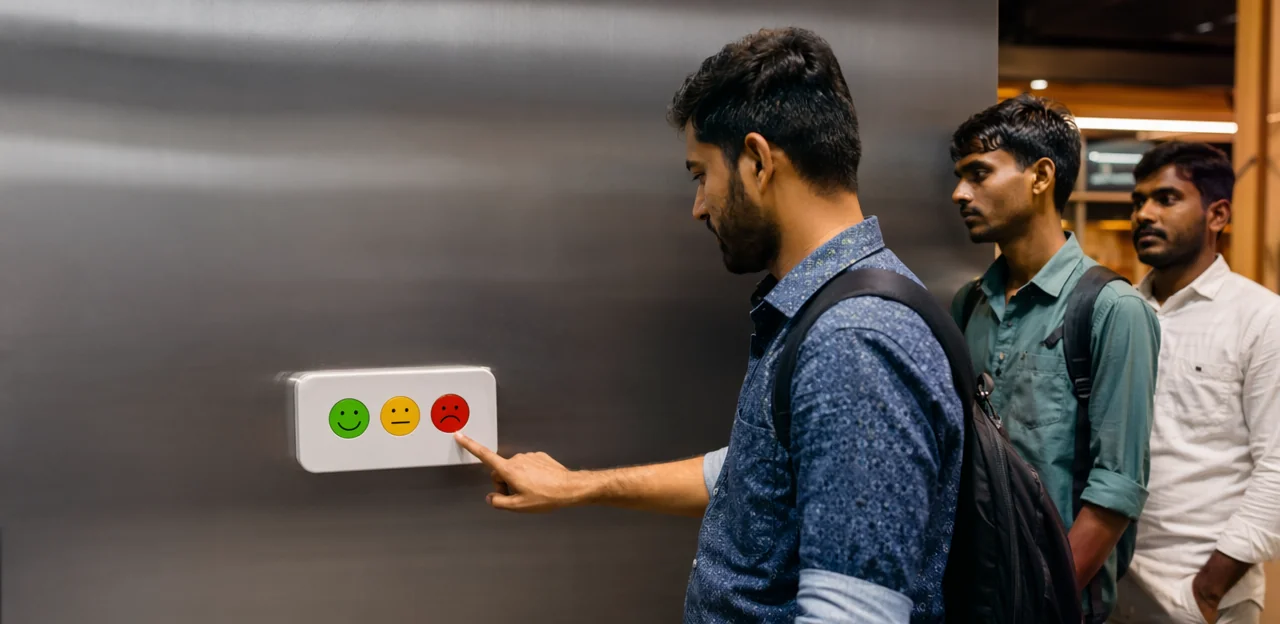
- Add smiley terminals for high-traffic areas: One-tap emoji feedback reduces friction and lifts participation.
- Offer QR surveys for follow-up: After a quick rating, let travelers scan for an optional comment or issue detail.
- Prioritize one-tap responses: The fewer fields, the better the response rate for any customer satisfaction survey.
If needed, tools like Tapsy can support no-app QR/NFC feedback flows that stay fast and intuitive.
Tailoring questions by location and passenger intent
A strong station feedback system should use location-based surveys that match what passengers are doing at each touchpoint. Relevant questions improve response quality and make action easier.
- Toilets: focus on toilet cleanliness feedback, restocking, odor, hygiene, and accessibility.
Example: “Were the toilets clean and fully stocked?” - Platforms: prioritize safety, crowd management, signage, announcements, and shelter comfort.
Example: “Was the platform overcrowded or difficult to navigate?” - Counters: use a waiting time survey plus questions on queue speed, staff helpfulness, and issue resolution.
Example: “How satisfied were you with waiting time and staff support?” - Lounges: ask about seating comfort, noise, cleanliness, Wi‑Fi, and accessibility.
Example: “Was the lounge comfortable and easy to use?”
Keep surveys short, context-specific, and triggered at the exact location for more accurate passenger insight.
Avoiding survey fatigue and biased responses
To improve feedback data quality, a station feedback system should make it easy to respond in seconds, not minutes. Keep surveys short, relevant, and tied to the exact touchpoint.
- Time it well: Ask immediately after the toilet visit, counter interaction, lounge stay, or platform wait, while the experience is still fresh.
- Use neutral wording: Write unbiased survey questions such as “How was the cleanliness?” instead of “How clean was the facility today?”
- Limit frequency: Avoid survey fatigue by not prompting the same passenger repeatedly across multiple station zones.
- Place prompts carefully: Position QR/NFC signs at exits or dwell points, not where they block flow or create pressure.
- Filter for actionability: Prioritize 1–3 core questions and one optional comment field; skip low-value questions that teams cannot act on.
Tools like Tapsy can support this touchpoint-based approach.
Best Use Cases by Station Area

Toilet feedback systems for cleanliness and maintenance
A toilet feedback system gives station teams real-time visibility into restroom conditions, helping them protect passenger trust and meet service standards. As part of a broader station feedback system, these devices capture fast, location-specific signals on:
- hygiene and overall cleanliness monitoring
- soap, tissue, and sanitizer shortages
- odors, blocked toilets, leaks, or damaged fixtures
- cleaning quality after a staff visit
When passengers submit restroom feedback at the exit or via QR/NFC touchpoints, low ratings can trigger alerts to housekeeping or maintenance immediately. This allows teams to fix issues before complaints escalate or affect compliance scores.
Trend data is equally valuable. Managers can identify peak problem times, high-traffic restrooms, recurring supply gaps, and repeat maintenance faults, then adjust cleaning rounds and staffing accordingly.
Solutions such as Tapsy can support no-app feedback collection, faster issue routing, and better documentation for audit and hygiene performance goals.
Platform feedback for safety, crowd flow, and information clarity
A station feedback system on platforms helps operators capture real-time platform feedback where passenger stress is often highest. Short, touchpoint-based surveys can reveal how travelers experience crowding, signage, announcements, delays, and overall safety perception.
- Crowding and movement: Collect crowd management insights on bottlenecks near stairs, elevators, doors, and boarding zones to improve queue control and platform layouts.
- Signage and wayfinding: Identify confusing signs, missed exits, or unclear transfer directions, then update maps, digital displays, and floor markings.
- Announcements and delays: Measure whether delay messages are timely, audible, and easy to understand across different platform areas.
- Perceived safety: Use station safety feedback to spot poor lighting, blind spots, unattended areas, or inconsistent staff presence.
This data supports faster incident response, better staff deployment, and clearer passenger communication. Solutions like Tapsy can help gather immediate, location-specific feedback without adding friction.
Counters and lounges: service quality, comfort, and staff performance
A station feedback system helps service desks and lounges capture experience signals at the exact moment passengers interact with staff or wait for assistance. This makes service counter feedback and lounge feedback more accurate and easier to act on.
Focus feedback on the factors that most influence satisfaction:
- Queue experience: wait time, queue clarity, perceived fairness, and whether passengers received help quickly
- Staff helpfulness: courtesy, problem-solving, knowledge, and multilingual support
- Comfort and amenities: seating availability, cleanliness, Wi-Fi, charging points, refreshments, noise, and temperature
- Premium expectations: fast-track service, exclusivity, privacy, and whether lounge benefits matched the ticket class or membership promise
For stronger staff performance feedback, keep surveys short and trigger alerts for low scores so supervisors can intervene quickly. Tools such as Tapsy can support QR/NFC touchpoint collection, helping teams spot recurring issues by counter, shift, or lounge zone.
Technology, Data Collection, and Reporting

A strong station feedback system should combine multiple collection channels, because no single method reaches every passenger segment.
- Feedback kiosk: Best for toilets, exits, lounges, and staffed counters where passengers can give a one-tap rating in seconds. High visibility and low effort make kiosks ideal for fast, high-volume sentiment capture.
- QR code survey: Works well on posters, queue barriers, tables, receipts, and doors. It gives more space for comments or issue categories, especially when passengers have a minute to respond.
- SMS: Useful after assistance, ticketing, or service recovery interactions when contact details are already available. It can lift response rates among less app-oriented users.
- Mobile passenger survey: Best for follow-up after the journey, allowing deeper questions on cleanliness, wait times, and staff service.
Using these channels together improves coverage across commuters, tourists, accessibility users, and infrequent travelers.
Turning raw responses into actionable operational insights
A strong station feedback system does more than collect ratings—it turns them into operational insights teams can act on fast. With feedback analytics and real-time reporting, managers can spot where problems occur, when they peak, and how serious they are.
- Dashboards group feedback by toilet, platform, counter, or lounge, helping teams compare locations and identify repeat problem areas.
- Alerts flag low scores or urgent comments instantly, so issues are routed to the right team without delay.
- Trend analysis reveals patterns such as evening cleanliness drops, weekend staffing pressure, or recurring equipment faults.
Typical escalation workflows include:
- Cleaning alerts sent to housekeeping supervisors
- Queue complaints routed to staffing or duty managers
- Maintenance issues escalated to technical teams for rapid repair
Platforms like Tapsy can support this closed-loop response model.
Privacy, accessibility, and integration considerations
A strong station feedback system should make passengers feel safe, included, and heard at every touchpoint. Prioritize:
- Data privacy in surveys: collect only necessary data, explain why it is needed, offer anonymous options, and display clear consent notices. Use secure storage, limited retention periods, and role-based access for staff.
- Accessible survey design: support screen readers, high-contrast layouts, large tap targets, plain language, and keyboard navigation where relevant. Ensure compliance with WCAG and local accessibility standards.
- Multilingual design: offer key station languages from the first screen, use simple wording, and avoid culture-specific phrasing that may confuse travelers.
- Feedback system integration: connect alerts and dashboards to facility management, cleaning workflows, CRM, or customer experience platforms so issues can be routed and resolved quickly.
Tools like Tapsy can support no-app, touchpoint-based collection when implemented with these safeguards.
Implementation Best Practices and Common Challenges

How to deploy a station feedback system successfully
Use a simple, phased feedback rollout plan to turn strategy into action:
- Set clear goals: Define what your station feedback system should improve—cleanliness, queue times, staff service, or lounge comfort—and choose 2–3 KPIs.
- Start with pilot locations: Test in high-traffic, high-impact areas such as toilets, ticket counters, and platforms to validate response rates and issue patterns.
- Align stakeholders: Involve operations, cleaning teams, station managers, IT, and customer experience leads early to support your wider passenger experience strategy.
- Train frontline staff: Explain escalation workflows, response expectations, and how feedback drives service recovery.
- Benchmark performance: Track volume, sentiment, resolution time, and repeat issues before scaling full station feedback system implementation.
Common mistakes to avoid
A station feedback system only works when it is easy to use and tied to action. Common feedback system mistakes include:
- Poor placement: Don’t hide surveys in low-traffic areas. Place them at the exact touchpoint—outside toilets, on platforms, at counters, and in lounges.
- Too many questions: Long forms create major survey implementation challenges. Keep it to 1–3 quick questions with an optional comment.
- No follow-up: If low scores do not trigger alerts or service recovery, feedback loses value.
- Siloed reporting: Share insights across operations, cleaning, customer service, and management.
- No owner: Follow customer feedback best practices by assigning clear operational responsibility for acting on results.
Measuring ROI and long-term success
To prove feedback system ROI, track both experience and operational outcomes from each station feedback system deployment:
- Customer satisfaction metrics: monitor touchpoint-level scores for toilets, platforms, counters, and lounges, then compare trends by location, shift, and time of day.
- Response rates: measure scans, submissions, and completion rates to see where survey design or placement needs improvement.
- Service improvement KPIs: track complaint reduction, repeat issue frequency, and average resolution time.
- Operational efficiency: connect feedback to cleaning cycles, staff dispatch times, queue length, and waiting-time improvements.
- Service recovery performance: measure alert response speed, issue closure rates, and whether low scores recover after intervention.
Platforms like Tapsy can help centralize these metrics for ongoing benchmarking and optimization.
How Feedback Improves Passenger Experience Over Time

Creating a continuous improvement loop
A strong station feedback system turns one-off comments into a practical feedback loop that drives continuous improvement across the hub. Recurring feedback helps teams spot patterns by location, shift, or service point, then confirm whether fixes actually improve results.
- Track repeated issues in toilets, platforms, counters, and lounges
- Compare scores before and after service changes
- Share insights with operations, cleaning, and customer service teams
- Set alerts for low ratings to trigger fast action
This creates accountability, supports passenger experience improvement, and builds a culture of responsiveness.
A station feedback system helps operators turn passenger sentiment into data-driven decisions that improve the right touchpoints first. Use feedback trends by location, time, and issue type to prioritize station service improvements and support mobility hub optimization:
- Increase staffing where queues, cleanliness, or assistance requests spike.
- Invest in amenities where lounges, toilets, or counters score below target.
- Prioritize maintenance for recurring faults, odors, lighting, or broken fixtures.
- Upgrade signage and accessibility where wayfinding confusion or mobility barriers appear.
- Expand premium services only where demand and satisfaction justify the spend.
Future trends in feedback systems for mobility hubs
The station feedback system is evolving from simple ratings into real-time operational intelligence. Key trends include:
- AI feedback analytics to detect sentiment, urgency, and recurring issues across toilets, platforms, counters, and lounges.
- Predictive maintenance triggers that turn repeated cleanliness or equipment complaints into automatic work orders.
- Integrated CX platforms that combine feedback with footfall, service, and staffing data.
- Smarter passenger journey measurement to track satisfaction across the full trip, not just one touchpoint.
For the future of passenger feedback, mobility hubs should prioritize smart station technology that enables fast action, closed-loop recovery, and clearer performance benchmarking.
Conclusion
In busy travel and mobility hubs, every touchpoint shapes the passenger journey. Toilets, platforms, service counters, and lounges are not just facilities—they are moments where delays, cleanliness issues, crowding, and service gaps directly affect satisfaction. A well-designed station feedback system helps operators capture these insights in real time, turning everyday interactions into actionable data that improves passenger experience, service recovery, and operational performance.
The most effective approach is simple, fast, and location-specific: short surveys, clear issue categories, and instant routing to the right teams. This allows transport operators to identify recurring problems, prioritize high-impact fixes, and benchmark performance across stations and service areas. Over time, a strong station feedback system supports better survey design, smarter resource allocation, and a more responsive travel environment.
If you want to improve passenger satisfaction and make feedback more useful at the point of experience, now is the time to review your current setup. Start by mapping your highest-traffic touchpoints, simplifying your survey flows, and defining alert rules for urgent issues. For teams exploring practical tools, solutions like Tapsy can help enable real-time, no-app feedback collection across physical locations. The next step is clear: build a station feedback system that listens where the journey happens—and acts before small issues become bigger problems.
Frequently Asked Questions
- What is a station feedback system?
A station feedback system collects passenger feedback at the exact touchpoint where an experience happens, such as toilets, platforms, counters, or lounges. It helps operators capture real-time insight on cleanliness, wait times, comfort, safety, and staff interactions.
- Why is real-time feedback important in travel and mobility hubs?
Conditions in busy stations can change quickly, so immediate feedback helps teams spot problems before they become larger complaints or service issues. It also supports faster service recovery by routing low scores or urgent comments to the right team.
- Which station areas benefit most from touchpoint-based feedback?
The highest-value areas are toilets, platforms, counters, and lounges because passengers notice and remember these touchpoints strongly. Feedback in these areas reveals issues related to cleanliness, crowding, queue times, comfort, safety, and staff service.
- What should a toilet feedback system measure?
It should focus on cleanliness, stock levels, odors, hygiene, accessibility, and maintenance problems such as leaks or blocked toilets. These signals help teams respond quickly and maintain trust, comfort, and perceived safety.
- How can platform feedback improve passenger experience?
Platform feedback can highlight crowding, signage problems, unclear announcements, delays, lighting concerns, and accessibility pain points. Operators can use this information to improve wayfinding, staff deployment, communication, and safety perception.
- What kinds of questions work best at service counters and lounges?
At counters, questions should cover waiting time, queue clarity, staff helpfulness, and issue resolution. In lounges, feedback should focus on seating comfort, noise, cleanliness, Wi-Fi, accessibility, and whether premium expectations were met.
- How long should a station feedback survey be?
It should be very short and easy to complete in seconds. A practical format is 1 to 3 core questions with an optional comment field, especially in high-traffic environments.
- Which response formats are most effective in busy station environments?
Simple 3- to 5-point rating scales work well because they are fast to understand and answer. One-tap smiley terminals reduce friction in high-traffic areas, while QR surveys can be used for optional follow-up comments.
- How can operators avoid survey fatigue and biased responses?
Prompts should appear immediately after the experience, use neutral wording, and avoid asking the same passenger repeatedly across multiple station zones. Surveys should also be placed at exits or dwell points so they do not interrupt flow or create pressure.
- What collection channels can be used in a station feedback system?
Common channels include feedback kiosks, QR code surveys, SMS, and mobile passenger surveys. Using several channels together improves coverage across different passenger groups, including commuters, tourists, accessibility users, and infrequent travelers.
- How does feedback become actionable for station teams?
Responses can be grouped in dashboards by toilet, platform, counter, or lounge to show where issues happen most often. Low scores and urgent comments can trigger alerts so cleaning, staffing, or maintenance teams can act quickly.
- What privacy and accessibility features should be included?
A strong setup should collect only necessary data, offer anonymous options, explain consent clearly, and use secure storage with limited retention. It should also support screen readers, high-contrast layouts, large tap targets, plain language, keyboard navigation, and multilingual design.
- What are the best first steps for implementing a station feedback system?
Start by defining clear goals such as improving cleanliness, queue times, staff service, or lounge comfort, then choose a small set of KPIs. Pilot the system in high-traffic areas, align key stakeholders, train frontline staff, and benchmark results before scaling.
- What common mistakes reduce the value of station feedback?
Poor survey placement, too many questions, missing follow-up actions, siloed reporting, and unclear ownership can all weaken results. Feedback only creates value when it is easy to submit and clearly tied to operational response.
- How can operators measure ROI and long-term success?
They can track touchpoint-level satisfaction scores, response rates, complaint reduction, repeat issue frequency, and average resolution time. It is also useful to connect feedback trends to cleaning cycles, staff dispatch, queue performance, and service recovery outcomes.