
A great meal can bring guests through the door once, but a consistently great experience is what keeps them coming back. For restaurants and cafés, that experience is shaped by more than just the food. Service speed, staff friendliness, cleanliness, ambiance, and whether guests feel they received good value all influence satisfaction, loyalty, and online reviews. That’s why asking the right restaurant survey questions is so important.
Well-designed surveys help operators move beyond guesswork and understand exactly what customers think at each stage of the dining experience. Instead of relying only on star ratings or occasional comments, restaurants can gather structured feedback that reveals what’s working, where problems are happening, and which improvements will have the biggest impact on revenue and retention.
In this article, we’ll explore practical restaurant survey questions across four essential areas: food, service, atmosphere, and value. You’ll learn how to design questions that generate useful insights, improve day-to-day operations, and support smarter pricing and customer experience decisions. We’ll also look at how real-time feedback tools such as Tapsy can help restaurants capture guest sentiment while the experience is still fresh, making it easier to resolve issues before they turn into negative reviews.
Why Restaurant Survey Questions Matter for Growth

Structured restaurant survey questions turn opinions into operational data teams can act on quickly. Instead of treating guest feedback as a branding metric, restaurants can use it to improve daily restaurant operations by spotting patterns such as:
- Kitchen execution issues: cold food, inconsistent taste, missing items, or poor timing between courses
- Staff performance gaps: friendliness, product knowledge, upselling, and problem resolution
- Wait-time bottlenecks: delays at seating, ordering, food delivery, or payment
- Cleanliness concerns: tables, restrooms, floors, and overall hygiene
- Overall satisfaction trends: whether guests would return or recommend the venue
When surveys are short, consistent, and reviewed regularly, managers can coach staff, fix process breakdowns, and prioritize improvements before negative reviews grow. Tools like Tapsy can also help capture feedback in real time.
Connecting surveys to ROI and pricing decisions
Well-designed restaurant survey questions turn guest feedback into pricing and profit insights. They help operators measure perceived value and connect experience quality to restaurant ROI.
- Ask guests whether portion size, food quality, speed, and service matched the price paid.
- Compare responses by menu category to see which dishes or experiences support premium restaurant pricing.
- Track comments about atmosphere, presentation, or staff attentiveness to learn what makes higher prices feel justified.
- Flag low value scores alongside visit frequency, average spend, and return intent to spot revenue leaks.
When guests say prices feel high but service or atmosphere disappoints, repeat visits often decline. Real-time tools such as Tapsy can help capture this feedback quickly, so teams can adjust pricing, improve execution, and protect margins.
What makes a restaurant survey effective
An effective set of restaurant survey questions is easy to answer and easy to act on. Good survey design should help you collect honest, specific feedback without overwhelming guests.
- Use clear wording: Keep every question simple, direct, and free of jargon.
- Keep it short: A focused customer satisfaction survey gets more completions than a long form.
- Follow a logical flow: Move from overall experience to food, service, atmosphere, and value.
- Use consistent rating scales: For example, 1–5 ratings make responses easier to compare over time.
- Mix question types: Combine quantitative scores with one or two open-text prompts in your restaurant feedback form.
This structure turns feedback into actionable insights your team can actually use.
Restaurant Survey Questions About Food Quality
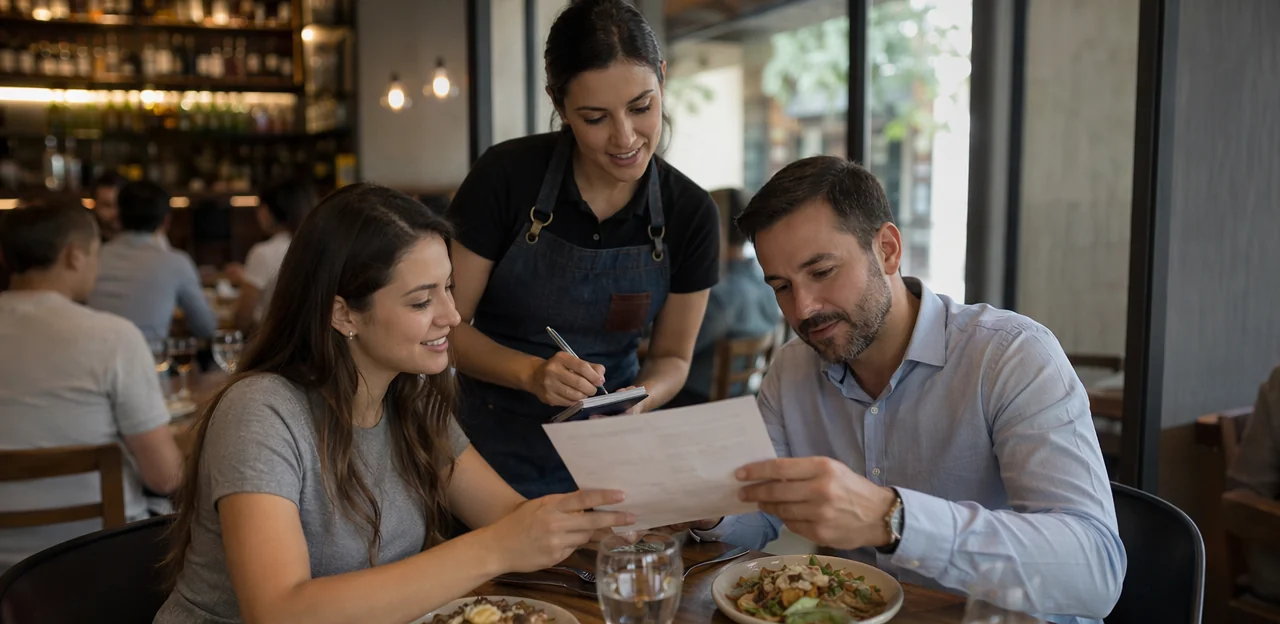
Use targeted restaurant survey questions to uncover what guests really think about your dishes and where kitchen execution needs work. Strong food quality survey questions should cover both first impressions and repeat-visit reliability, such as:
- How would you rate the flavor and seasoning of your meal?
- Was your food served at the right temperature?
- How appealing was the presentation of the dish?
- Did the ingredients taste fresh?
- Was the portion size appropriate for the price?
- How consistent was this meal compared with previous visits?
These questions generate practical restaurant food feedback that helps identify issues like overcooking, weak seasoning, inconsistent plating, or declining freshness. Over time, response patterns can guide recipe adjustments, portion control, staff training, and prep standards to protect menu quality. If you collect feedback in real time through tools like Tapsy, teams can spot recurring kitchen problems faster and act before they affect more guests.
Questions for menu variety and dietary preferences
Strong restaurant survey questions in this area help you understand whether guests feel the menu is broad, relevant, and inclusive. Use menu survey questions that go beyond “Did you like the food?” and uncover gaps in choice and accessibility.
Consider asking:
- Did the menu offer enough variety for your tastes?
- Were there appealing seasonal or limited-time items?
- Did you notice enough healthy options on the menu?
- How satisfied were you with the vegetarian or vegan choices?
- Did the restaurant clearly accommodate allergies or other dietary preferences?
- Was allergen or ingredient information easy to find and understand?
This type of restaurant menu feedback shows whether your menu meets modern expectations, supports different lifestyles, and reduces friction for guests with restrictions. For faster, in-the-moment input, tools like Tapsy can help restaurants collect feedback while the dining experience is still fresh.
How to turn food feedback into action
To get more value from restaurant survey questions, organize food feedback into clear categories such as taste, temperature, portion size, presentation, freshness, and consistency. This makes patterns easier to spot and act on.
- Tag recurring complaints: Group similar comments like “served cold,” “too salty,” or “small portions” to identify repeat issues by dish, shift, or location.
- Compare item-level feedback: Use restaurant analytics to rank menu items by ratings, complaint volume, reorder intent, and profit margin.
- Refine recipes: If specific dishes underperform, adjust ingredients, prep methods, seasoning, or plating based on common feedback themes.
- Support menu engineering: Combine survey results with sales data to promote high-performing dishes, rework weak items, or remove poor-value options.
- Strengthen quality control: Turn feedback into kitchen checklists, staff training points, and line checks for ongoing food quality improvement.
Tools like Tapsy can help capture real-time dish-level feedback while the experience is still fresh.
Restaurant Survey Questions About Service Experience

Questions about speed, attentiveness, and professionalism
Service often determines whether a guest returns, even more than the meal itself. Strong restaurant service quality creates trust, reduces friction, and drives repeat visits, which is why these restaurant survey questions should measure every key service touchpoint.
Sample service survey questions:
- Were you greeted promptly when you arrived?
- How satisfied were you with the wait time to be seated, served, and receive your food?
- Was your order accurate and complete?
- How friendly and courteous was the staff?
- Did team members seem knowledgeable about the menu, specials, or dietary needs?
- How quickly did staff respond when you needed help?
- How smooth and efficient was the checkout or payment process?
This kind of customer service feedback helps restaurants identify staffing gaps, training needs, and process bottlenecks. Tools like Tapsy can also help capture real-time feedback while the experience is still fresh.
Questions for dine-in, takeout, and delivery service
Strong restaurant survey questions should reflect how guests actually order and receive food, because the dine-in experience differs greatly from pickup or delivery. Use channel-specific prompts such as:
- Dine-in: Was your table ready on time? Were staff attentive, accurate, and friendly throughout the meal?
- Takeout survey questions: Was pickup simple and clearly organized? Was the order complete, labeled correctly, and packaged to maintain temperature and freshness?
- Drive-thru: Was the line length reasonable? Was communication clear at the speaker and handoff window?
- Delivery feedback: Did the order arrive on time, sealed, and in good condition? Were drinks secure and hot or cold items kept at the right temperature?
Also ask about handoff quality, status updates, and issue resolution. Segmenting feedback by service type helps operators spot whether problems come from front-of-house, packaging, dispatch timing, or third-party delivery execution.
Using service feedback for staff coaching
Well-designed restaurant survey questions give managers a practical roadmap for staff training and ongoing service improvement. Instead of coaching from guesswork, use guest feedback to spot patterns by shift, role, and location.
- Identify training gaps: Look for repeated comments about slow greetings, order accuracy, menu knowledge, or upselling. Turn these into targeted coaching topics.
- Recognize top performers: Highlight staff members or teams consistently praised by guests, and use their habits as examples in team training.
- Refine scripts and workflows: If surveys show confusion during seating, ordering, or payment, update service scripts and simplify handoff processes.
- Standardize expectations: Compare results across shifts and locations to ensure every guest receives the same level of care.
For stronger restaurant management, review feedback weekly, share clear action points, and track whether coaching improves future scores. Tools like Tapsy can help capture real-time service insights.
Restaurant Survey Questions About Atmosphere and Ambience

Questions about cleanliness, comfort, and layout
Use restaurant survey questions to uncover how the physical space shapes the dining room experience. A strong restaurant atmosphere survey should ask guests to rate:
- Cleanliness of the dining room, tables, floors, and high-touch surfaces
- Restroom condition, stocking, odor, and overall hygiene
- Seating comfort, chair stability, and table size
- Table spacing and privacy between parties
- Noise levels during peak and off-peak hours
- Lighting comfort for dining, reading menus, and ambiance
- Ease of movement for guests and staff, including aisles and entryways
Pair scaled ratings with one open comment field for specific cleanliness feedback. If you use real-time tools like Tapsy, you can spot layout or hygiene issues before they affect more guests.
Questions about brand feel and guest mood
Use restaurant survey questions that measure whether the space delivers the intended brand experience, not just whether it looks nice. Focus on emotional and brand-fit cues that shape guest perception of your restaurant ambience.
- Ask guests to rate descriptors such as: welcoming, relaxing, upscale, family-friendly, trendy, or comfortable.
- Include a brand-alignment question: “Did the atmosphere match what you expected from our restaurant?”
- Compare promise vs. reality with prompts like: “How well did our ambience reflect our brand?”
- Add an open-text follow-up so guests can explain what influenced their mood.
Keep scales consistent and review results by daypart, location, or seating area to spot patterns.
Improving atmosphere based on survey insights
Use restaurant survey questions to turn subjective atmosphere comments into clear operational fixes. Strong restaurant design feedback helps operators prioritize the changes that most improve customer experience and drive ambience improvement.
- Music: Adjust volume, genre, and tempo by daypart if guests mention noise, rushed dining, or low energy.
- Lighting: Brighten lunch areas for comfort and dim evening zones for warmth and longer stays.
- Décor: Refresh dated elements, add greenery, or simplify clutter when feedback suggests the space feels tired or inconsistent.
- Seating layout: Rework table spacing, bar seating, and waiting areas to reduce crowding and improve privacy.
- Maintenance: Fast-track fixes for worn furniture, odors, temperature issues, or restroom cleanliness.
Tools like Tapsy can help capture real-time atmosphere feedback at key touchpoints.
Restaurant Survey Questions About Value and Pricing

Questions that measure value for money
Use restaurant survey questions that uncover how guests judge price against quality, quantity, and the full dining experience. A strong value for money survey should go beyond “Was it expensive?” and explore price perception in context.
- Did your meal feel worth the price you paid?
- How would you rate the value for money of your overall visit?
- Did portion sizes match your expectations for the menu price?
- Was the quality of the food consistent with what you expected at this price point?
- Did the service and atmosphere justify the total amount spent?
- Compared with similar restaurants, how fair were our prices?
These prompts generate practical restaurant pricing feedback you can use to refine menu pricing, bundle offers, or adjust portion sizes.
Questions about promotions, upsells, and loyalty
Use restaurant survey questions to learn which offers actually influence ordering behavior and repeat visits. Focus on measuring response to restaurant promotions without training guests to wait for discounts.
- Ask which specials or bundles felt most relevant and why.
- Measure whether add-ons felt helpful, tempting, or too sales-driven.
- Include loyalty program feedback questions such as how easy it was to join, understand, and redeem rewards.
- Test discount sensitivity by asking whether guests would return without a coupon.
- Track upselling effectiveness with questions about suggested sides, drinks, desserts, or premium upgrades.
Compare responses against average check size, redemption rates, and repeat visits. Tools like Tapsy can help capture this feedback at the point of purchase for more accurate insights.
Balancing guest satisfaction with profitability
Use restaurant survey questions about value to see whether guests feel prices match portion size, quality, and service—not just whether menu items seem “expensive.” Then compare that feedback with core financial metrics:
- Food costs: If value scores are low and food costs are high, review portioning, waste, or ingredient mix before raising prices.
- Labor costs: If service ratings are strong but margins are thin, adjust staffing by daypart instead of cutting guest-facing quality.
- Average check size: If guests rate value highly and check averages are rising, your pricing strategy may support stronger upsells.
This combined view improves ROI analysis and supports smarter decisions that protect guest experience while growing restaurant profitability.
How to Design, Distribute, and Analyze Restaurant Surveys

Best practices for survey format and timing
Use these survey best practices to improve completion rates and get better feedback from your restaurant survey questions:
- Keep it short: Aim for 5–8 questions or under 2 minutes. Focus on food, service, atmosphere, and value.
- Prioritize mobile survey design: Most guests respond on phones, so use large buttons, one-question-per-screen, and minimal typing.
- Send a post-dining survey quickly: Ask within 1–24 hours of the visit while details are still fresh.
- Choose clear rating scales: A consistent 1–5 scale works well for speed, comparison, and reporting.
- Use open-ended questions selectively: Add 1 optional comment box for detailed feedback; use multiple choice for faster answers and easier analysis.
Tools like Tapsy can also help collect quick, mobile-first feedback at the right moment.
Where to collect responses and boost completion rates
To improve your survey response rate, ask restaurant survey questions where guests already interact with your brand:
- Email follow-ups: Send within 2–24 hours of the visit with a short subject line and one clear CTA.
- SMS surveys: Best for fast, mobile-friendly completion after dine-in or pickup.
- QR code survey links: Add them to receipts, table tents, menus, and exit signage for instant restaurant feedback collection.
- Loyalty apps and online ordering follow-ups: Trigger surveys after delivery, pickup, or points redemption.
To increase completions:
- Keep surveys under 1–2 minutes
- Offer small incentives like discounts or free items
- Personalize messages and time them close to the visit
- Use tools like Tapsy for no-app QR feedback and reward flows
How to analyze results and close the feedback loop
To get real value from restaurant survey questions, turn responses into clear action steps through consistent survey analysis:
- Segment feedback by location, daypart, order type (dine-in, delivery, takeaway), and customer type (new, repeat, loyalty members).
- Track trends in scores and comments to uncover recurring issues in food quality, speed, atmosphere, or pricing.
- Tie findings to restaurant KPIs such as table turn time, ticket size, repeat visits, and complaint rate.
- Prioritize fixes by focusing first on high-frequency, high-impact problems.
- Close the loop by sharing customer feedback insights with managers and frontline teams, then telling guests what changed through signage, email, social posts, or receipts.
Tools like Tapsy can help teams monitor feedback in real time across locations.
Conclusion
Well-crafted restaurant survey questions give restaurants and cafés a practical way to understand what guests really think about food quality, service speed and friendliness, atmosphere, and overall value. When your survey is focused, concise, and tied to the full dining experience, it becomes more than a feedback tool—it becomes a roadmap for better operations, stronger customer loyalty, and smarter pricing decisions.
The most effective restaurant survey questions are specific enough to reveal what is working and where friction exists, whether that is menu consistency, wait times, cleanliness, ambiance, or whether guests feel the experience matched the price they paid. By regularly collecting and acting on this feedback, restaurant teams can spot trends early, improve service recovery, and make changes that directly impact guest satisfaction and ROI.
Now is the time to review your current survey strategy and refine the questions you ask at every key touchpoint. Start by identifying your top business goals, testing a shorter survey format, and tracking responses over time. If you want to capture real-time feedback in a simple, guest-friendly way, tools like Tapsy can help streamline the process. For your next step, explore survey templates, benchmark your results, and keep optimizing your restaurant survey questions to turn guest insights into measurable growth.
Frequently Asked Questions
- Why are restaurant survey questions important for growth?
They turn guest opinions into operational data that teams can act on quickly. Restaurants can use them to spot patterns in kitchen execution, staff performance, wait times, cleanliness, and overall satisfaction. When reviewed regularly, the feedback helps managers fix issues before they lead to negative reviews or lost repeat visits.
- What makes a restaurant survey effective?
An effective survey is short, clear, and easy to act on. It should follow a logical flow from overall experience to food, service, atmosphere, and value, while using consistent rating scales such as 1–5. Mixing ratings with one or two open-text prompts helps collect both measurable and specific feedback.
- Which food quality questions should restaurants ask guests?
Useful food questions cover flavor, seasoning, temperature, presentation, freshness, portion size, and consistency across visits. These prompts help uncover issues like weak seasoning, overcooking, poor plating, or declining freshness. Over time, the responses can guide recipe changes, portion control, and kitchen training.
- How can restaurants gather feedback about menu variety and dietary needs?
They can ask whether the menu offered enough variety, included healthy options, and provided satisfying vegetarian or vegan choices. It also helps to ask whether allergies and dietary preferences were clearly accommodated and whether ingredient or allergen information was easy to understand. This reveals whether the menu feels inclusive and relevant to different guest needs.
- How should food feedback be turned into action?
Organize feedback into categories such as taste, temperature, portion size, presentation, freshness, and consistency. Tag recurring complaints like cold food or small portions, then compare item-level feedback with sales and profit data. That process supports recipe refinement, menu engineering, and stronger quality-control routines.
- What service experience questions help identify operational problems?
Strong service questions ask about greeting speed, wait time, order accuracy, staff friendliness, menu knowledge, responsiveness, and checkout efficiency. These touchpoints show where staffing gaps, training needs, or process bottlenecks are affecting the guest experience. They are especially useful for understanding whether service quality supports repeat visits.
- Should survey questions differ for dine-in, takeout, drive-thru, and delivery?
Yes, because each service type has different friction points. Dine-in feedback should focus on table readiness and attentiveness, while takeout should cover pickup organization, labeling, and packaging. Drive-thru and delivery questions should address line length, communication, arrival timing, order condition, and temperature control.
- How can managers use service feedback for staff coaching?
Managers can review comments by shift, role, and location to identify repeated issues such as slow greetings, poor order accuracy, or weak menu knowledge. The feedback can then be turned into targeted coaching topics, updated service scripts, and clearer standards. It also helps highlight top performers whose habits can be used in team training.
- What should restaurants ask about atmosphere and ambience?
Good atmosphere questions cover cleanliness, restroom condition, seating comfort, table spacing, noise levels, lighting, and ease of movement. Restaurants can also ask whether the space felt welcoming, relaxing, upscale, family-friendly, trendy, or comfortable. One open comment field helps capture specific details behind the ratings.
- How can survey responses improve a restaurant's physical environment?
Feedback can point to practical fixes in music, lighting, décor, seating layout, and maintenance. For example, comments about noise may lead to volume changes, while complaints about crowding may suggest reworking table spacing or waiting areas. Repeated notes about worn furniture, odors, or restroom issues can help prioritize maintenance.
- How do restaurant surveys measure value for money?
They ask guests whether the meal felt worth the price, whether portion sizes matched expectations, and whether food quality, service, and atmosphere justified the total spend. Comparing prices with similar restaurants can also reveal how fair guests perceive the pricing to be. These responses help operators understand price perception in context rather than in isolation.
- How can feedback support pricing and profitability decisions?
Value scores can be compared with food costs, labor costs, average check size, visit frequency, and return intent. If guests feel prices are high while service or atmosphere disappoints, repeat visits may decline. This combined view helps restaurants adjust pricing, portioning, staffing, or execution without relying on guesswork.
- What is the best format and timing for a restaurant survey?
A strong format is mobile-friendly, takes under two minutes, and usually includes 5–8 questions. Sending it within 1–24 hours after the visit helps capture details while the experience is still fresh. Consistent 1–5 rating scales and limited typing improve completion and make reporting easier.
- Where should restaurants collect survey responses to improve completion rates?
Responses can be collected through email follow-ups, SMS, QR codes on receipts or table tents, loyalty apps, and online ordering follow-ups. Completion rates improve when surveys are short, timed close to the visit, and paired with a clear call to action. Small incentives such as discounts or free items can also encourage participation.
- How can tools like Tapsy help with restaurant feedback collection?
Real-time tools like Tapsy help capture guest sentiment while the experience is still fresh. That makes it easier to spot issues in food, service, atmosphere, or value before they turn into negative reviews. They can also support mobile-first collection methods such as QR feedback and point-of-purchase responses.