
A repair may be complete, but the resident experience doesn’t end when the contractor leaves. In housing, every maintenance visit shapes trust, influences satisfaction, and affects how residents feel about the overall quality of service they receive. That’s why a well-designed maintenance satisfaction survey is more than a routine follow-up—it’s a practical tool for understanding what happened during a repair, what went well, and where service gaps still exist.
When sent at the right time and built around the right questions, these surveys help housing providers capture honest feedback while the visit is still fresh. They can reveal whether appointments were kept, communication was clear, the issue was resolved first time, and the resident felt respected throughout the process. Just as importantly, they provide actionable insight for improving contractor performance, reducing repeat visits, and strengthening resident experience across the board.
In this article, we’ll explore the most effective questions to ask after repairs and service visits, how to structure surveys for better response rates, and what housing teams can learn from the feedback they collect. We’ll also touch on how real-time feedback tools such as Tapsy can support faster issue capture and more responsive service improvement.
Why a maintenance satisfaction survey matters in housing
How post-repair feedback improves resident experience
Collecting post-repair feedback gives housing providers a clear view of what residents actually experience after a job is completed. A well-designed maintenance satisfaction survey helps teams move beyond “job done” metrics and understand whether the repair was timely, respectful, and fully resolved.
Key benefits include:
- Understanding resident expectations: Learn what matters most, such as communication, punctuality, cleanliness, and first-time fixes.
- Identifying service gaps: Spot recurring issues with contractors, delays, missed appointments, or poor workmanship.
- Improving trust: Asking for feedback shows residents their voice matters and creates opportunities to resolve problems quickly.
- Driving better decisions: Use survey data to refine processes, train staff, and benchmark service quality across properties.
Tools like Tapsy can help capture feedback quickly while the service visit is still fresh.
Operational benefits for housing and property teams
A well-designed maintenance satisfaction survey turns resident feedback into practical performance data for housing maintenance and asset teams. It helps managers spot issues early, improve accountability, and raise repair service quality across contractors and in-house teams.
- Strengthen contractor management: Track satisfaction by contractor, trade, job type, and postcode to identify underperformance and support evidence-based reviews.
- Improve first-time fix rates: Compare survey feedback with repeat visits, parts delays, and completion data to find where jobs are not resolved first time.
- Monitor communication standards: Measure whether residents were kept informed about appointments, delays, access needs, and next steps.
- Benchmark services consistently: Use property management surveys to compare teams, regions, and repair categories over time.
Platforms such as Tapsy can also help capture faster, touchpoint-level feedback after service visits.
What success looks like after service visits
A strong maintenance satisfaction survey should show clear, measurable outcomes that support long-term housing service improvement. Success is not just about collecting feedback, but using it to improve future visits.
Useful signs of progress include:
- Higher service visit satisfaction scores after completed repairs
- Faster issue resolution, especially for repeat or urgent faults
- Better communication ratings, including clear arrival times, updates, and follow-up
- Stronger accountability for repair teams through team-level reporting and trend tracking
- Improved repair satisfaction metrics, such as first-time fix rates and fewer repeat complaints
Review results monthly and compare by contractor, repair type, and property area. This helps housing teams spot recurring problems, coach staff, and prioritise changes that residents will notice quickly.
What to ask in a maintenance satisfaction survey
Core questions after repairs and maintenance visits
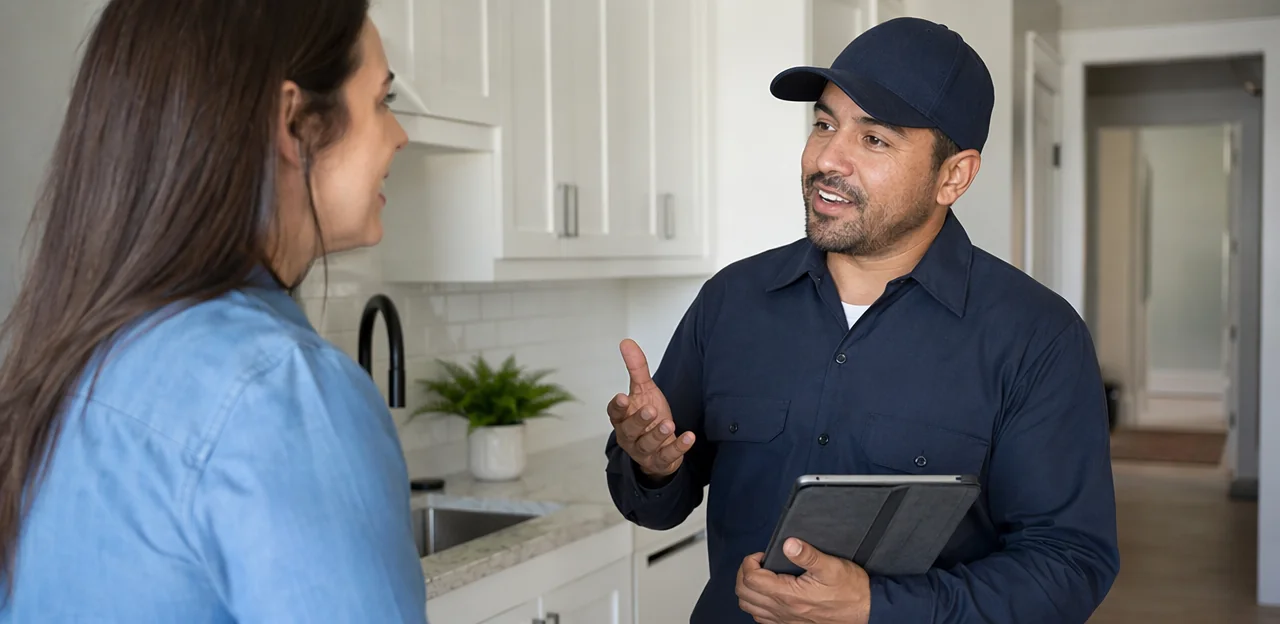
A strong maintenance satisfaction survey should focus on the parts of the visit residents notice most and that teams can improve quickly. Keep your post-maintenance survey short, specific, and easy to answer.
Include core maintenance satisfaction survey questions such as:
- Timeliness: Was the repair completed within a reasonable timeframe?
- Professionalism: Was the operative polite, respectful, and professional during the visit?
- Quality of repair: Are you satisfied with the standard of the work carried out?
- Cleanliness: Was the area left clean and tidy after the repair?
- Communication: Were you kept informed about appointment times, delays, and what work would be completed?
- Resolution: Was the issue fully resolved on this visit?
To make your repair survey questions more useful, add a rating scale plus one open-text prompt like: “What could we have done better?” This helps identify repeat issues, poor communication, or incomplete jobs. If you want faster, in-the-moment responses after a visit, tools like Tapsy can help capture feedback while the experience is still fresh.
Open-ended questions that reveal resident insights
A strong maintenance satisfaction survey should go beyond rating scales. While scores show trends, open-ended survey questions explain why residents felt satisfied or frustrated after a repair or service visit. Adding one or two well-placed comment prompts helps teams capture specific details that numbers often miss.
Use resident feedback questions such as:
- What did the technician do well during the service visit?
- Was anything left unresolved after the repair?
- Do you have any additional service visit comments about communication, cleanliness, or timeliness?
- Have you experienced this issue before? If yes, please describe it.
These prompts help housing teams:
- identify staff members who communicate clearly, arrive prepared, and treat residents respectfully
- uncover recurring faults, repeat callouts, or building-wide issues hidden behind acceptable ratings
- spot process gaps such as poor follow-up, missed appointments, or incomplete repairs
To make comments actionable, review responses by repair type, property, and contractor. Tag themes consistently so repeated problems can be escalated quickly and used to improve service quality.
Questions to avoid for better response quality
A strong maintenance satisfaction survey depends as much on the questions you avoid as the ones you ask. Poor wording lowers response quality, creates biased results, and makes it harder to improve service. In resident survey design, watch for these common mistakes:
- Leading questions: Avoid phrasing like “How satisfied were you with our fast and professional repair service?” This pushes residents toward a positive answer.
- Double-barreled questions: Don’t ask, “Was the contractor polite and was the repair completed properly?” A resident may agree with one part but not the other.
- Too many rating scales: Switching between 1–5, 1–10, and “excellent to poor” in one survey creates confusion. Consistent scales are a core part of survey design best practices.
- Unclear terminology: Terms like “responsive repairs,” “first-time fix,” or “planned works” may not be clear to all residents. Use plain, everyday language.
To reduce bad survey questions, keep each question focused on one issue, use neutral wording, and test the survey with a small resident group before launch.
How to design surveys residents will complete

Choosing the right survey length and format
A maintenance satisfaction survey works best when it is quick, clear, and sent soon after the repair or service visit. In most cases, a short satisfaction survey will improve survey response rates because residents are more likely to complete 3–5 focused questions than a long form.
Use this simple maintenance survey design approach:
- Ask 1–2 rating questions on timeliness, quality of repair, and staff professionalism
- Include one optional open-text question for specific comments
- Add a clear yes/no question such as whether the issue was fully resolved
- Keep mobile completion easy, with large buttons and minimal typing
This balance gives you actionable feedback without creating friction. If you need deeper insight, use follow-up surveys only for low scores or unresolved jobs.
Best channels for sending post-repair surveys
Choose resident communication channels based on urgency, digital access, and accessibility needs. For a maintenance satisfaction survey, a mixed-channel approach usually delivers the best response rates.
- SMS survey: Best for fast feedback after routine repairs. Works well for mobile-first residents and short, 1–3 question surveys. Keep links simple and mobile-friendly.
- Email satisfaction survey: Ideal when you want longer comments, photos, or follow-up detail. Useful for residents comfortable with digital communication and for non-urgent service reviews.
- Phone surveys: Better for older residents, vulnerable households, or cases involving complaints, complex repairs, or low literacy.
- App surveys: Suitable if residents already use a housing portal or repairs app. Avoid relying on this channel alone.
- Paper surveys: Important for digitally excluded residents and some supported housing settings.
Where possible, let residents choose their preferred channel.
When to send the survey after a service visit
Getting resident feedback timing right makes a maintenance satisfaction survey far more useful. Send it while the experience is fresh, but after the resident has had time to judge the outcome.
- Completed standard repairs: Send the after service visit survey within 24 hours of the job being marked complete. This improves post-repair survey timing and captures clear feedback on punctuality, communication, and repair quality.
- Emergency callouts: Send an initial survey within 12–24 hours, when urgency and staff response are still memorable. If the fix was temporary, send a second short survey after the permanent repair.
- Follow-up visits: Wait until the final visit is completed, then send the survey within 24 hours so residents can assess whether the issue was fully resolved.
Use automated triggers to match survey timing to each job type.
Using survey results to improve housing maintenance services

Turning satisfaction data into service improvements
A maintenance satisfaction survey only creates value when responses lead to action. Use survey data analysis to combine scores with open-text comments and spot recurring service failures.
- Segment results by repair type, contractor, estate, and trade to identify where low satisfaction clusters.
- Track missed appointments by comparing punctuality scores, “no access” codes, and comments mentioning late arrivals or no-shows.
- Flag poor workmanship by reviewing repeat repair requests, low quality ratings, and phrases such as “not fixed” or “temporary repair.”
- Monitor communication failures through feedback on updates, explanations, and follow-up after visits.
- Benchmark contractor performance using satisfaction scores, complaint rates, first-time fix rates, and completion times.
This approach supports maintenance service improvement and stronger repair performance tracking. Tools like Tapsy can also help capture timely feedback closer to the service visit.
Reporting results to teams and contractors
Turn each maintenance satisfaction survey into clear, role-specific reporting so teams can act quickly and improve service quality.
- Give operatives practical dashboards: show first-time fix rates, punctuality, communication scores, and repeat visit trends by trade, job type, and area.
- Set shared housing KPIs: track resident satisfaction, average completion time, no-access rates, complaint volumes, and follow-up success across internal teams and contractors.
- Use contractor performance metrics in reviews: combine survey scores with operational data, such as missed appointments, recall jobs, and resolution times, to create fair, evidence-based discussions.
- Keep reviews resident-centered: include verbatim comments, themes, and examples of good service recovery, not just percentages.
- Standardise maintenance reporting: use monthly scorecards and quarterly performance reviews so managers and external contractors can compare results consistently.
Tools like Tapsy can help centralise feedback and dashboard reporting.
Closing the feedback loop with residents
A maintenance satisfaction survey only builds value when residents see that their feedback leads to action. Closing the feedback loop means reporting back clearly, promptly, and consistently so residents know their voice matters. This strengthens trust, improves resident engagement, and supports better housing customer satisfaction.
- Share what changed: for example, faster repair scheduling, improved contractor standards, or clearer appointment updates.
- Use simple follow-ups: send a text, email, or notice saying, “You told us X, so we did Y.”
- Report trends regularly: monthly updates in newsletters, portals, or communal areas show accountability at scale.
- Acknowledge unresolved issues: explain what is still being reviewed and when residents can expect an update.
Tools such as Tapsy can help teams capture feedback quickly and communicate actions faster.
Best practices for survey design, compliance, and inclusivity
Writing clear, accessible questions for all residents
To improve response quality, every maintenance satisfaction survey should be easy to read, answer, and access across different resident needs. Strong accessible survey design helps you hear from more people, not just the most confident or digitally fluent.
- Use plain language surveys: avoid jargon like “rectification works” and ask simple questions such as “Was the repair completed properly?”
- Offer translation options and culturally neutral wording for multilingual communities.
- Make surveys mobile-friendly, screen-reader compatible, and easy to navigate with large text and clear buttons.
- Use inclusive resident surveys with respectful wording that does not assume age, literacy, disability, or household type.
If using digital tools, platforms like Tapsy can help simplify access through no-app feedback links or QR touchpoints.
Privacy, consent, and data handling considerations
A maintenance satisfaction survey should make residents feel safe sharing honest feedback. Strong survey privacy practices improve response quality and trust.
- Get clear feedback consent: explain why you are collecting feedback, how it will be used, and whether follow-up contact may occur.
- Offer anonymity options: let residents respond anonymously where possible, especially for sensitive service or staff comments.
- Limit data collection: only ask for details needed to improve repairs and resident experience.
- Protect resident data: use secure survey tools, encrypted storage, role-based access, and retention limits to support resident data protection.
- Be transparent: include a short privacy notice and contact point for data questions.
Platforms such as Tapsy can support simple, secure feedback collection when configured responsibly.
Benchmarking and tracking satisfaction over time
A strong maintenance satisfaction survey becomes more valuable when housing providers use the same core questions after every repair or service visit. Consistency makes survey benchmarking possible, helping teams compare contractors, property types, and time periods on a like-for-like basis.
- Keep a standard set of questions on timeliness, quality of repair, communication, and overall satisfaction.
- Report results monthly or quarterly to support reliable satisfaction tracking.
- Compare scores before and after process changes, such as new appointment systems or contractor training.
- Segment results by trade, region, or repair type for better housing performance measurement.
Simple dashboards or tools such as Tapsy can help turn survey data into clear operational trends.
Sample maintenance satisfaction survey template

A simple post-repair survey example
A practical maintenance satisfaction survey can stay short while capturing useful repair feedback:
- Rating question: “How satisfied were you with the repair visit?” (1–5)
- Yes/No question: “Was the issue fully resolved on this visit?”
- Open-text question: “What could we have done better?”
This post-repair survey example works as a flexible maintenance satisfaction survey template or repair feedback form for both routine and emergency repairs.
How to tailor questions by repair type
Keep one maintenance satisfaction survey structure, but adapt wording to the job completed:
- Gas: ask about safety explanations, access arrangements, and confidence in the engineer.
- Electrical: focus on fault resolution, testing, and whether power was restored safely.
- Plumbing: ask about leak resolution, cleanliness, and any follow-up needed.
- Communal areas: cover visibility, disruption, and shared-area standards.
- Emergency visits: measure response speed and reassurance.
This keeps repair type survey questions, property maintenance survey data, and housing repairs feedback comparable.
Recommended KPIs to track from responses
Use your maintenance satisfaction survey to monitor a small set of actionable maintenance satisfaction KPIs:
- Overall satisfaction / repair satisfaction score
- Completion rate: was the job fully completed?
- First-time fix rate: solved without repeat visits
- Communication score: updates, timing, and clarity
- Operative professionalism: courtesy, respect, cleanliness
- Resolution confirmation: resident agrees the issue is resolved
These resident feedback metrics help teams spot service gaps, improve contractor performance, and reduce repeat repairs.
Conclusion
A well-designed maintenance satisfaction survey does more than measure whether a repair was completed—it reveals how residents experienced the entire service journey, from reporting the issue to the quality of communication, timeliness, professionalism, and confidence in the final fix. By asking the right post-repair and post-service visit questions, housing providers can identify recurring problems, improve contractor performance, strengthen resident trust, and turn feedback into practical service improvements.
The most effective maintenance satisfaction survey keeps questions clear, relevant, and easy to answer while giving residents space to share what worked and what still needs attention. When surveys are timely and action-oriented, they help teams move beyond compliance and build a better resident experience across every touchpoint.
The next step is to review your current survey design, remove unnecessary questions, and focus on insights that lead to faster follow-up and better repair outcomes. You may also want to explore benchmarking, response-rate strategies, and real-time feedback tools that help capture resident sentiment while the experience is still fresh. For organisations looking to modernise feedback collection, solutions like Tapsy can support faster, touchpoint-based responses.
Now is the time to refine your maintenance satisfaction survey so every repair visit becomes an opportunity to improve service, accountability, and resident satisfaction.
Frequently Asked Questions
- What is a maintenance satisfaction survey in housing?
A maintenance satisfaction survey is a follow-up survey sent after a repair or service visit to understand how the resident experienced the service. It helps measure things like timeliness, communication, professionalism, cleanliness, and whether the issue was fully resolved.
- Why should housing providers send surveys after repairs are completed?
Post-repair surveys help teams move beyond simple completion metrics and understand what residents actually experienced. They can reveal service gaps, improve trust, and provide practical insight for improving contractor performance, reducing repeat visits, and strengthening overall service quality.
- What questions should be included in a post-repair survey?
Useful questions cover timeliness, professionalism, quality of repair, cleanliness, communication, and whether the issue was resolved on that visit. A rating scale plus one open-text prompt such as asking what could have been done better makes the feedback more actionable.
- How many questions should a maintenance satisfaction survey have?
A short survey usually works best, with around 3 to 5 focused questions. A simple structure can include 1 to 2 rating questions, one yes/no question about resolution, and one optional open-text comment.
- When is the best time to send a maintenance satisfaction survey?
For standard completed repairs, sending the survey within 24 hours of the job being marked complete helps capture fresh and useful feedback. Emergency callouts can be surveyed within 12 to 24 hours, and follow-up visits should be surveyed after the final visit is completed.
- Which channels work best for sending post-repair surveys?
SMS works well for fast feedback after routine repairs, while email is better when longer comments or follow-up detail are needed. Phone and paper surveys are important for residents with accessibility needs, low literacy, or limited digital access, and app surveys can work if residents already use a housing portal.
- What open-ended questions help uncover better resident feedback?
Good open-ended prompts ask what the technician did well, whether anything was left unresolved, and whether the resident has comments on communication, cleanliness, or timeliness. Asking if the issue has happened before can also help uncover repeat faults or wider building problems.
- What types of survey questions should be avoided?
Avoid leading questions that push residents toward a positive answer and double-barreled questions that ask about two issues at once. It is also better to avoid inconsistent rating scales and unclear technical terms that residents may not understand.
- How can survey results be used to improve housing maintenance services?
Survey responses should be reviewed alongside comments and operational data to identify recurring failures. Segmenting results by repair type, contractor, estate, and trade helps teams spot low-performing areas, monitor missed appointments, and track poor workmanship or communication problems.
- What does success look like after using maintenance satisfaction surveys?
Useful signs of progress include higher satisfaction scores, faster issue resolution, better communication ratings, and fewer repeat complaints. Stronger accountability through team-level reporting and trend tracking also shows that feedback is being used effectively.
- How should housing teams report survey findings to staff and contractors?
Results should be turned into clear, role-specific reporting such as dashboards, monthly scorecards, and quarterly reviews. Reporting should include practical measures like first-time fix rates, punctuality, communication scores, complaint volumes, and resident comments to support fair, evidence-based discussions.
- Why is it important to close the feedback loop with residents?
Closing the feedback loop shows residents that their feedback leads to action, which helps build trust and improve engagement. Simple updates explaining what changed, what is still under review, and when further updates will come make the process more transparent.
- How can maintenance surveys be made accessible and inclusive?
Questions should use plain language, avoid jargon, and be easy to answer on mobile devices. Surveys should also support translation options, screen-reader compatibility, large text, and respectful wording that does not assume age, literacy, disability, or household type.
- What privacy and consent practices should be followed when collecting repair feedback?
Residents should be told why feedback is being collected, how it will be used, and whether follow-up contact may happen. Good practice also includes offering anonymity where possible, limiting data collection, protecting data securely, and providing a short privacy notice with a contact point for questions.
- How can survey questions be tailored for different repair types without losing consistency?
Keep the same core survey structure, but adjust wording to match the job type. For example, gas repairs can ask about safety explanations, electrical repairs can focus on testing and safe power restoration, plumbing can ask about leak resolution and cleanliness, and emergency visits can measure response speed and reassurance.